
Description
Author : Dr. Vijyendra Kumar (Author)
Dr. Gamini Sahu, Dr. Damodhar M. Ghime (Co-Author)
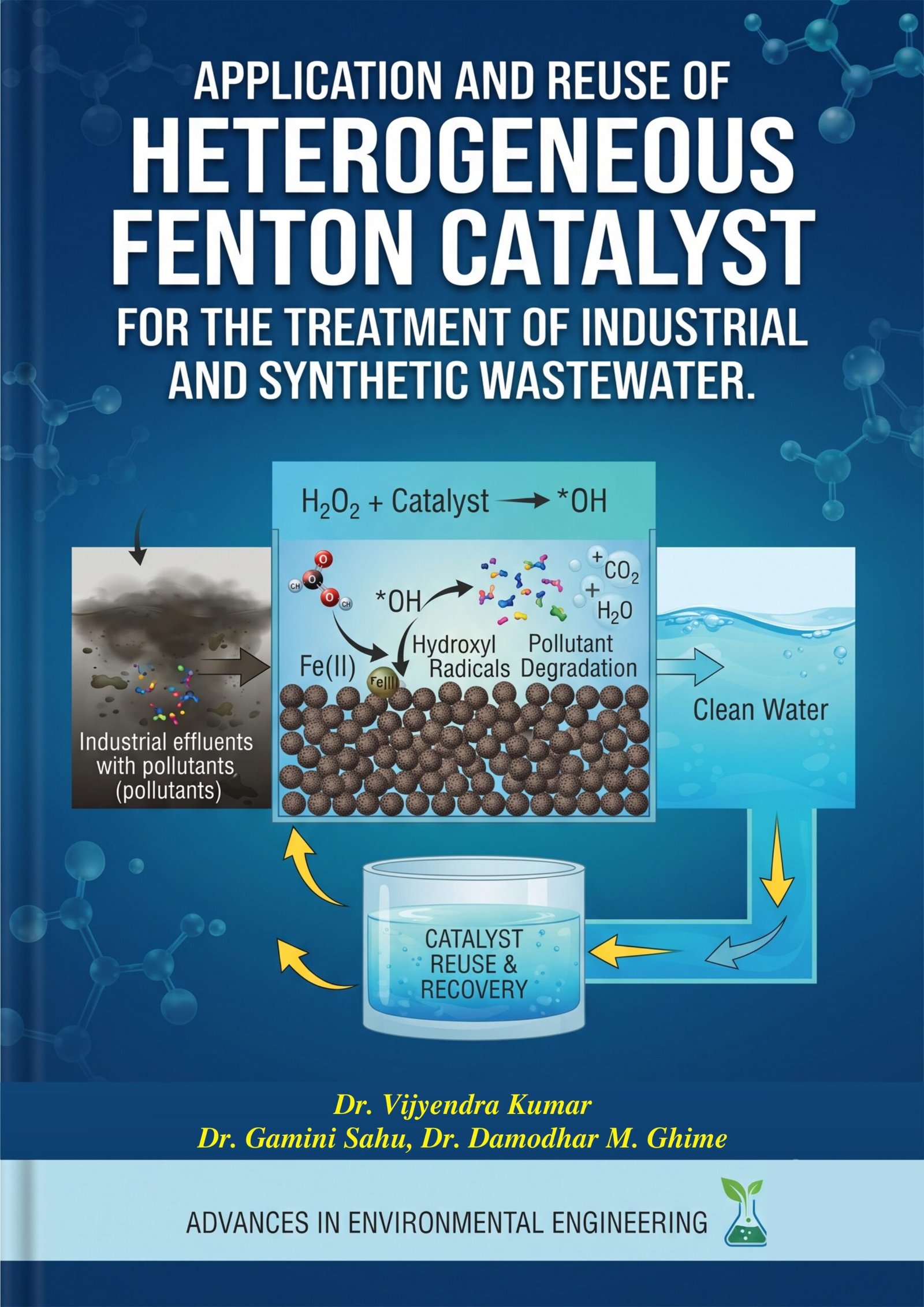
This thesis focuses on the different factors, modification in the synthesis method, characterization and application of heterogeneous catalyst in the wastewater treatment based on the Fenton process. The present work highlights the different catalyst preparation method such as wet impregnation method, hydrothermal method, sol-gel method, precipitation method and their application to treat different recalcitrant organic chemicals. Major heterogeneous catalyst synthesis methods were discussed which have already been proven for their excellent workability. The importance of modification through physical and chemical method was also reported. Different catalyst, pollutants and optimum parametric conditions available in the literature along with some relevant studies are summarized. The effect of factors like pH, calcination and some other modifiers on the synthesis and their efficiency in the wastewater treatment has been described. The important characterization of synthesized catalysts which directly or indirectly explain their working efficiency has also been discussed. In the final section, the application of heterogeneous catalyst synthesized by different methods in the wastewater/effluent treatment has been investigated. The main aim of the work is to find out the influence of process parameters and catalytic method on degradation/decolorization of organic compounds present in industrial or synthetic wastewater.
In this study, the degradation of mixed dye (mixture of Azure B and Congo Red) was investigated using iron loaded black soil as a catalyst via Fenton process. Iron loaded black soil catalyst was prepared by the wet impregnation method, calcined at different temperature with varying of iron loading on black soil and their behavior was compared through characterization techniques (FTIR and XRD). Separately, the effect of calcination and aging of catalyst was investigated on the degradation of mixed dye with optimized conditions. Significant degradation (> 90% only in 10 min) was observed in optimum condition. Toxicity measurement was done by a seed germination test which gave significant result. In the kinetic study, it was found that Behnajady-Modirshahla-Ghanbery (BMG) model was best suited for this Fenton process compared to other models. In addition, thermodynamic properties (Gibbs free energy (∆G), Activation energy (Ea), Activation Enthalpy (∆H), and Activation Entropy (∆S)) were also calculated. The stability of synthesized catalyst was also found to be satisfactory.
Our main focus is the utilization of naturally occurring hematite for the treatment of wastewater. Present work shows the decolorization of mono-azo dye Rifafix Red-3BN by environmentally friendly advanced oxidation processes using natural hematite. The experimental variables was initial concentration of dye, catalyst concentration, oxidant concentration and reaction temperature. The optimum conditions were obtained as: catalyst dose 2 g/L, H2O2 concentration 20 mM, pH 3 and temperature 25oC at a reaction time of 60 min. The % decolorization was increased from 55.91% to 93.89% using optimum conditions with initial 100 ppm dye. The activation energy was also studied between the temperature ranges of 25oC to 80oC. To assess the competence of different types of AOPs, the organic mono-azo dye was subjected to oxidize using various photochemical processes.
Advanced oxidation process (AOP) is an efficient method to treat wastewater generated from pulp and paper industry. Hydroxyl radical (•OH) is responsible for the degradation of organic pollutant generated by the reaction of iron ion and hydrogen peroxide in the Fenton process. In this study, real wastewater was taken from pulp and paper industry, India. The lignin is mainly responsible for high Chemical Oxygen Demand (COD) in pulp and paper wastewater. For the present investigation, three independent variables were chosen COD: H2O2, H2O2: Fe2+ and time. The maximum 94% COD removal was found at the optimized value of 0.165, 0.0165 and 115 for the COD:H2O2, H2O2:Fe2+ and time respectively. The response surface methodology (RSM) was applied to optimize the operational parameters.
Black soil (BS) was used as a catalyst for the decolorization of Azure B dye by Fenton process. BC was modified by acid, alkali, distilled water, and calcination was done to check their efficiency on decolorization of Azure B. Among three modified catalysts, maximum decolorization was obtained by acid-modified BS (AMBS) catalyst. Highest decolorization of 97.59 % was achieved only in 10 min (calcination of 100°C and aging of 3 hrs). AMBS was considered as the main catalyst for optimizing the different process parameter. Optimized conditions were obtained: pH 2, 0.2 ml of H2O2, catalyst dose 0.3 g, room temperature (30°C), stirring speed 400 rpm). BET surface area and pore volume of AMBS was calculated as 79.402 m2/g and 0.0608 m3/g respectively. More than 95 % decolorization was achieved only in 5 to 10 minutes. AMBS has good recycling ability. More than 85% of color was removed even after 4 cycles run. Three stage kinetic studies were also investigated.
Copper ferrite (CuFe2O4) catalyst was synthesized by co-precipitation method and oxidation of organic matter present in pulp and paper was investigated effluent in laboratory scale. The Taguchi optimization method was employed using an orthogonal array with five levels for the experimental design in the fixed bed reactor. Influence of process variables such as pH, concentration of H2O2, bed height and reaction time was optimized for the chemical oxygen demand (COD) removal by analysing statistically. After 2 hrs of reaction time, with optimized parameters, about 78 % COD removal was achieved. COD removal from wastewater followed first order kinetics with rate constant 0.014 min-1. A thermodynamic study was carried out to find the properties like enthalpy, entropy and Gibbs free energy. It gave and as 21.984KJ mol-1 and -208.071KJmol-1 K-1. Catalyst reusability and stability was checked by regenerated catalyst. The catalyst showed good reusability for four consecutive runs and amount of Fe and Cu in treating effluent was found to be below discharge limit. The concentration of Fe and Cu was measured by atomic absorption spectrophotometer (AAS).
Reviews
There are no reviews yet.